I am currently
working on this page. More information coming soon; please check
back.
Heartworms
Heartworms
are not really worms, but parasites transferred to your dog usually
via the bite of mosquitoes. Heartworms and "intestinal worms"
(intestinal parasites: tape worms, roundworms, whipworms &
threadworms) are not the same thing. Natural prevention begins
with identifying how at risk your animal is. If you live in a
high risk area (mosquito infested), your dog's coat should never
be cut, so that it can serve it's natural function of a protective
barrier against mosquitoes. Use natural insect deterrents (Note:The FDA does not allow the use of the word "repellant"
on any natural insect "deterrents.") Proper nutrition
and immune system support will help build and maintain your dog's
resistance to the parasite. In addition to extra vitamins and
minerals being added to the proper, well balanced natural diet,
you could also add garlic and/or Immune
Support Tincture, which may help strengthen the immune system.
When taking a trip into a high risk area, Echinacea
could be given for three days before the trip and continued three
days afterwards.
Black walnut,
pumpkin seed and other herbal treatments cannot be relied on to
cure heartworms because these work in aiding to expel worms from
the digestive tract, and heartworms never enter the digestive
tract. If your dog contracts heartworm, do not rely on home administered
herbal remedies but instead, contact a holistic vet right away.
Fleas
Like other
holistic health care approaches, we need to try to look at the flea
issue differently. It's not holistic to just switch to an herb from
a chemical to attempt to kill all the fleas. We do not just address
the symptoms that the fleas cause (itching), but to get to the cause
of the allergic reaction that the flea bite stimulates in a vulnerable
pet. Fleas, like all parasites, prey on the weak, sick, and malnourished.
An animal infested with fleas is an unhealthy animal and we must
ask ourselves why are the fleas bothering the them in the first
place, rather than solely focusing on the elimination of the fleas.
Holistic therapy does not begin with shampoos, coat dips, rinses,
or sprays; it begins by strengthening the animal and making their
home less hospitable to the fleas. It means getting your pet healthy
enough, with a healthy coat and properly functioning immune defenses,
so that fleas will cause no allergic reaction in him (itching) and
ultimately the fleas will have no interest in him. The real key
is a good, nutritional diet.
To a your pet's
nutritional diet, you can add garlic and brewers yeast with Vit
B. These exude odors or tastes that discourage fleas. Add a clove
of garlic or 1/4 teaspoon granulated garlic to your pets meal. Add
1 tablespoon of brewer's yeast (1/2 Tbls. for small dogs and cats)
to your pets daily meals. Every two days, sprinkle brewer's yeast
on their coats and work it in with your hands. This dose not kill
the fleas, it just makes them want to leave, so make sure to let
your dog outside and give the house a good vacuum.
Other additions
to your pet's diet that could be burdock root, dandelion, and red
clover. These serve as useful dietary adjuncts by helping the body
eliminate waste and allowing natural defense systems to work more
freely in coping with fleabites. Nettle
may be sprinkled onto your pet's food to lend nutritive support
and a mild antihistamine action that may reduce the severity of
an allergic reaction. Giving 1/2 -1 teaspoon of dried herb for each
pound of food fed is a good starting dose.
To address fleas
by external methods, your pet's living quarters can be sprinkled
with diatomaceous earth (also called DE). For more info on DE, please
click here. Vacuuming
is a great way to keep down fleas.
You can look
for herbal flea powders that contain garlic as well as various flea
deterring herbs such as wormwood and pennyroyal. I make an herbal
pillow stuffing for our dog and cats' beds, which helps discourage
fleas (Note:The FDA does not allow the use of the
word "repellant" on any natural insect "deterrents.").
You can find the recipe for the pillows
below.
Lately, I have
used my Shoo-Fly Spray on our dog to
aid in deterring fleas, ticks and bothersome flies when she is outside.
If your pet
has a real infestation that needs to be taken care of right away,
or if some of the nontoxic products you have tried just aren't working
for you, there are some over-the-counter chemical treatments you
can safely try. Look for products containing citrus based d-limonene,
and herbal insecticide. If you have a real severe problem, I recommended
Front Line. I do not recommend any other the other products that
come in the small plastic vials, they are not all the same and some
are down right dangerous. Frontline is a different chemical and
the only one I recommenced (and it really works). If you look around
on the Internet, you can find this product at a fairly low price
(much lower than buying it from a vet).
Herbal
Anti-Flea Pillows
Use
this Anti-Flea Herb Mix in these various ways:
1) Make/Sew
little pillows (8 "X 8" or so) stuffed with the
following mix and place in the animals bed or sleeping area.
The little pillow cannot be washed and you will have to replace
it every couple of months.
2) If
your pet has a cedar stuffed bed (cedar is a great flea deterrent).
Stuff the bed with cedar chips and throw this herb mix in
with the chips as you fill the bag. Change the entire filling
of the bag every couple of months.
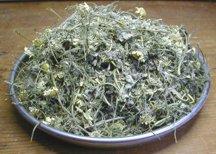
Herbal
Flea Deterrent Pillow Filling Recipe:
mix
together:
2
cups Pennyroyal*
1
cup Rosemary
1
cup Feverfew
1
cup Southernwood
(if you can't find this, use Wormwood)
* Do not
let the animal eat this herbal mix. Pennyroyal should not
be consumed. If there is a chance the animal will tear up
the pillow, use peppermint instead of Pennyroyal, it will
not be quite as effective, but will be safer.
Vaccinations
We
choose not vaccinate our animals and we have good reasons. Please
check out the following links to read more on this subject
Clumping
Clay Kitty Litters: A Deadly Convenience?
Clumping
clay kitty litters may be related to a wide variety of seemingly
unrelated cat health problems, included diarrhea, frothy yellow
vomiting, mega-bowel syndrome, irritable bowel syndrome, kidney
problems, respiratory problems, general failure to thrive, anemia,
lethargy, and even death.
I, personally,
had no idea that kitty litter could be dangerous, or cause any type
of health problem but now, in hind sight, I believe that clumping
kitty litter contributed to the death of our cat Woodpyle. Because
of this, I would like to share with you this information so you
can be pre warned. We now use SweetScoop (kitty litter made from
wheat) and it is great. Not only is it safe, it works better than
the "classic" (and dangerous) clumping litters. It can
be purchased at PetSmart, IGA grocery stores and Ingles (I purchase enough for 3 months every time
I make the trek to Knoxville.) I found the "trick" to
using this littler is making sure you have a real nice deep layer
(3"-4"). I got rid of our standard sized litter pans and
started using a approx. 15" wide X 20 " long X 12" tall
Rubbermaid plastic storage container I found at Wal-Mart. It's the
best littler box ever! It works really well, especially with three
cats.
Mange is
a skin disease of mammals caused by mites that burrow under the
top layers of skin that cases itching, hair loss, painful lesions,
etc. This condition is difficult to get rid of.
All of the mange-causing
mites have one thing in common: they are all opportunity seeking
parasites that prefer a defenseless host. Therefore, prevention
in the form of a well-balanced natural diet that provides immune
system support should begin before an infection occurs. I recommend
using Immune Support/Boost
in conjunction
with whatever other treatment you decide to try.
Here
are a few things you can try:
Tea
Tree oil:
Wash the
animal with gentle soap and water. Remove excess hair by clipping
or shaving it off. Use a spray bottle to saturate the affected
area with the following mixture of tea tree oil and water. Mix
1 Tbsp. of pure Tea
Tree
oil with 1 Cup water. When using the spray, shake the bottle
vigorously and often. Saturate the area with this mixture and
let stay on fo-15 minutes. Dry the animal with paper towels
(throw out the towel after using).
For suborn
areas, saturate a cotton ball with pure Tea
Tree
oil and apply to the area. Do this 2 times daily, for at least
a week or until signs of mange are gone.
Garlic:
Mites don't
tolerate sulfur compounds, and garlic contains hundreds of them.
Ear
Mite Oil:
(click here for information on how
to purchase this oil already made)
One
part Mullein Infused Oil
One
part Garlic Infused Oil
10-20
drops of Vit. E oil for each 1 oz of garlic & mullein
oil mixture
Other
Herbs to consider:
Lavender,
Yarrow, Oregon Grape and Licorice. Any of these herbs can
be used in oils, salves, or ointments as well, or they can
be made into a skin rise.
* Disclaimer: The
information and statements presented on this site have not been
evaluated or approved by the
Food and Drug Administration. The use of herbs and essential
oil for the prevention, treatment or cure of disease has not
been approved by the
FDA
or USDA.
We
therefore make no claims to this effect. The information and
products offered on this web site are not intended to diagnose,
treat,
cure or
prevent any disease.
We
are not veterinarians or doctors. The information on this site
is based on the traditional and historic use of herbs as well
as personal experience and is provided for general reference and
educational purposes only. It is not intended to diagnose, prescribe
or promote any direct or implied health claims. This information
is and products are not intended to replace professional veterinary and/or medical
advice. You should not use this information to diagnose or treat
any health problems or illnesses without consulting your vet and/or
doctor. We present the products on this site and the information
supplied here without guarantees, and we disclaim all liability
in connection with the use of these products and/or information.
Any person making the decision to act upon this information is
responsible for investigating and understanding the effects of
their own actions. Please
read our Services and Conditions
of Use and Limitation Of
Liability policy.
Copyright (c) 1997-2007 Fias Co Farm/Molly Bunton. All rights reserved.
All text written by Molly Bunton unless otherwise noted.
All graphics, photos and text on these pages
were created by, and are
the sole property of, Fias Co Farm. Individuals are granted the right to download a single
copy of this page for archival purposes on electronic media and/or
conversion into a single printed copy for personal use.
All other
use or reproduction of this material, such as in publications or use on other web
sites is strictly prohibited. It may not
otherwise be reprinted or recopied, in whole or in part, in any
form or medium, without express written permission of Fias Co
Farm.
This site may be used as a referance if proper credit is provided and a web link is given.